
Weight Loss Supplements: What to Know About Safety, Claims, and Results
Most over-the-counter “diet” products lead to small changes at best, and the biggest risk is not that they fail, it’s that they can be unsafe for the wrong person. A safer strategy is to treat them as optional add-ons and focus first on food quality, calorie awareness, movement, sleep, and a plan tailored to your health history.
If you live in Greenville, Winterville, Ayden, Farmville, or anywhere in Pitt County, you have the same challenge as everyone else: marketing is loud, results are inconsistent, and it is hard to know what is real.
Learn more about our supplement support overview Best Weight Loss Supplements: Evidence-Based Picks
Why these products are so tempting (and why results vary)
People usually reach for a bottle when one of these happens: the scale stalls, appetite feels unmanageable, stress eating ramps up, or a big event is coming and time feels short. The promise is simple: burn more, eat less, or block calories.
The reality is that most non-prescription products, even the “popular” ones, do not overcome the basics. If you are not in a consistent calorie deficit, no ingredient reliably creates one for you. And if you are already doing the basics well, the “boost” from a pill is often too small to notice.
Another reason results vary is that bodies vary. Sleep debt, perimenopause, insulin resistance, thyroid disease, medications, and even a demanding shift schedule can all change hunger, energy, and how your body responds to the same plan. That is why two friends can take the same product and get different outcomes.
What a label can and cannot promise in the U.S.
A quick way to protect yourself is to understand what “dietary supplement” means legally. In the U.S., these products are not reviewed and approved for effectiveness before they hit the shelf. The FDA explains that, under DSHEA, it does not have authority to approve dietary supplements before marketing, and companies are generally responsible for product safety and labeling.
“Structure/function” claims are not the same as proven results
Many labels use language like “supports metabolism,” “helps manage appetite,” or “promotes fat breakdown.” Those are structure/function style claims, not proof that the product will produce meaningful weight change for most people.
You will often see a disclaimer that the statement has not been evaluated by the FDA. That is your reminder that you are not looking at the same standard used for prescription medications.
The biggest red flags to notice fast ✅
You do not need a long checklist. A few signals catch most risky products:
✅ Promises of rapid loss (“10 pounds in a week”)
✅ “Same as” or “just like” a prescription injection or pill
✅ “Detox,” “flush,” or “melt fat” language with no mechanism explained
✅ “Proprietary blend” with no individual ingredient amounts
✅ Sales pages that hide the full Supplement Facts panel until checkout
✅ Claims that it works even with “no diet or exercise”
If you see two or more of these together, it is usually smarter to walk away.
Safety first: who should be extra careful
This topic is not just about “does it work.” It is also about “is it safe for me.”
If any of the following applies, speak with a clinician before using stimulant-heavy or hormone-leaning products:
⚠️ High blood pressure, fast heart rate, irregular rhythm, or chest pain history
⚠️ Anxiety, panic symptoms, or poor sleep (stimulants can backfire)
⚠️ Diabetes medications (especially if you are prone to low blood sugar)
⚠️ Blood thinners or clotting disorders
⚠️ Pregnancy, trying to conceive, or breastfeeding
⚠️ Liver disease, kidney disease, or a history of pancreatitis
Also remember that “natural” does not guarantee “gentle.” Some plant extracts are pharmacologically active, and combining multiple extracts can increase side effects.
Common ingredient categories and what to realistically expect
The NIH Office of Dietary Supplements notes there is little scientific evidence that many ingredients commonly promoted for weight loss work, and it provides safety and effectiveness summaries for common components.
Here is a practical way to think about what you are buying: not by brand names, but by ingredient categories.
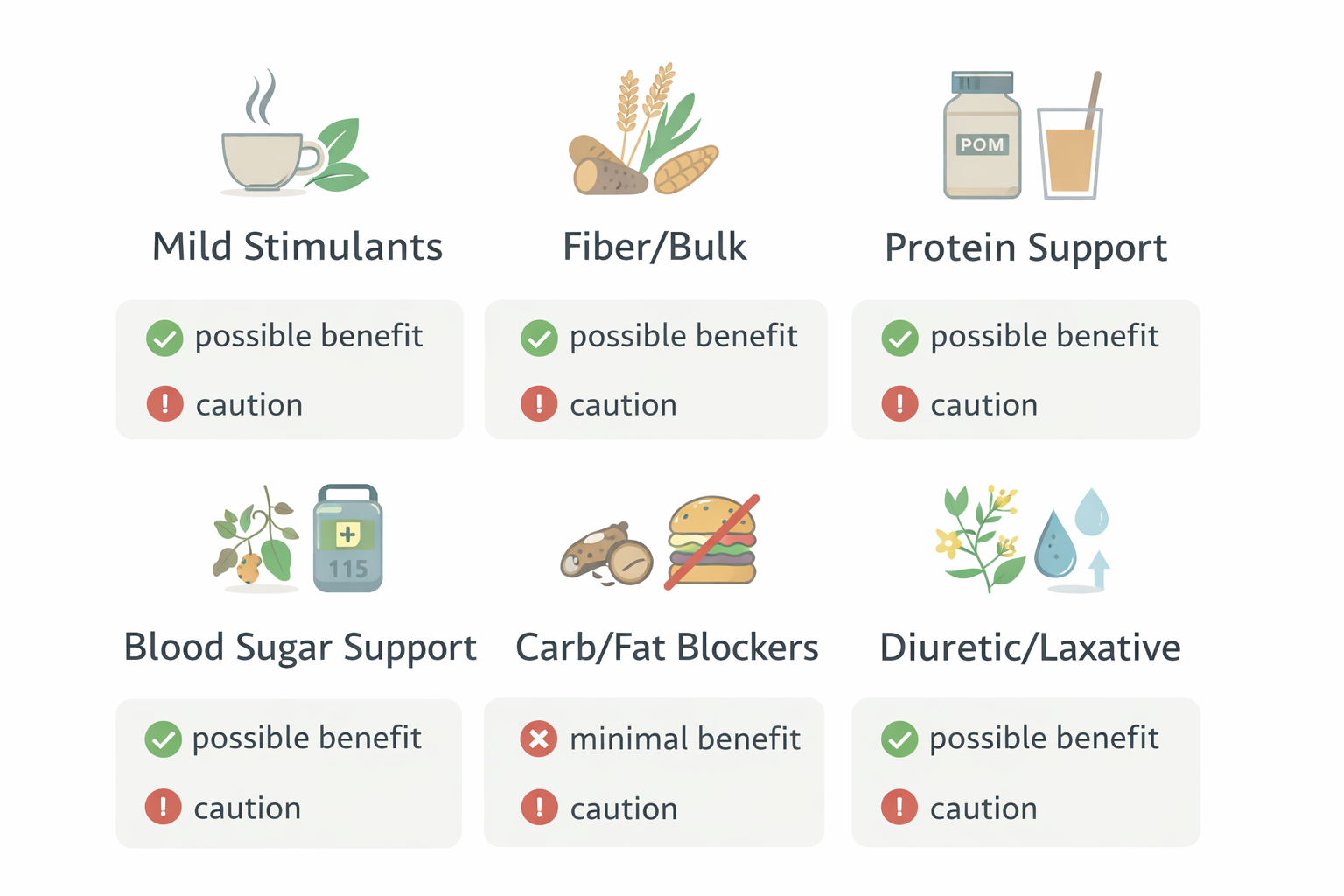
Quick comparison table (benefit vs trade-offs)
| Category | Common examples | What it may help with | Common downsides / cautions |
|---|---|---|---|
| Mild stimulants | caffeine, green tea extract | short-term energy, slightly higher calorie burn | jitters, anxiety, higher blood pressure, sleep disruption; extracts may be riskier than brewed tea |
| Fiber / bulk | psyllium, glucomannan | feeling full, steadier appetite, improved regularity | bloating, gas; must take with enough water |
| Protein support | protein powder, high-protein meal replacement | satiety, muscle support during calorie deficit | can upset stomach in some; quality varies |
| “Blood sugar” support | berberine (common in this space) | may improve glucose markers for some people | GI upset, medication interactions; not for everyone |
| “Carb/fat blockers” | various blends, chitosan | usually minimal real-world effect | often disappointing; may cause GI issues |
| Diuretic/laxative style | senna, “water loss” blends | scale drops from water and stool | dehydration risk, cramps, not fat loss |
A note for women looking for the best supplements for weight loss female
Many women are sold “hormone balance” formulas with vague promises. The more practical approach is to match the tool to the real barrier:
If the barrier is hunger: fiber and protein strategies tend to be safer and more predictable than stimulant stacks.
If the barrier is fatigue and stress: sleep, iron status (if applicable), and overall calorie quality usually beat “fat burner” blends.
If the barrier is perimenopause weight creep: strength training, adequate protein, and a clinician-guided plan often matter more than any bottle.
The “best” option is the one that fits your medical history and does not create side effects that sabotage consistency.
How to check quality before you purchase (without becoming an expert)
The fastest quality screen is not a brand’s marketing. It is how transparent they are.
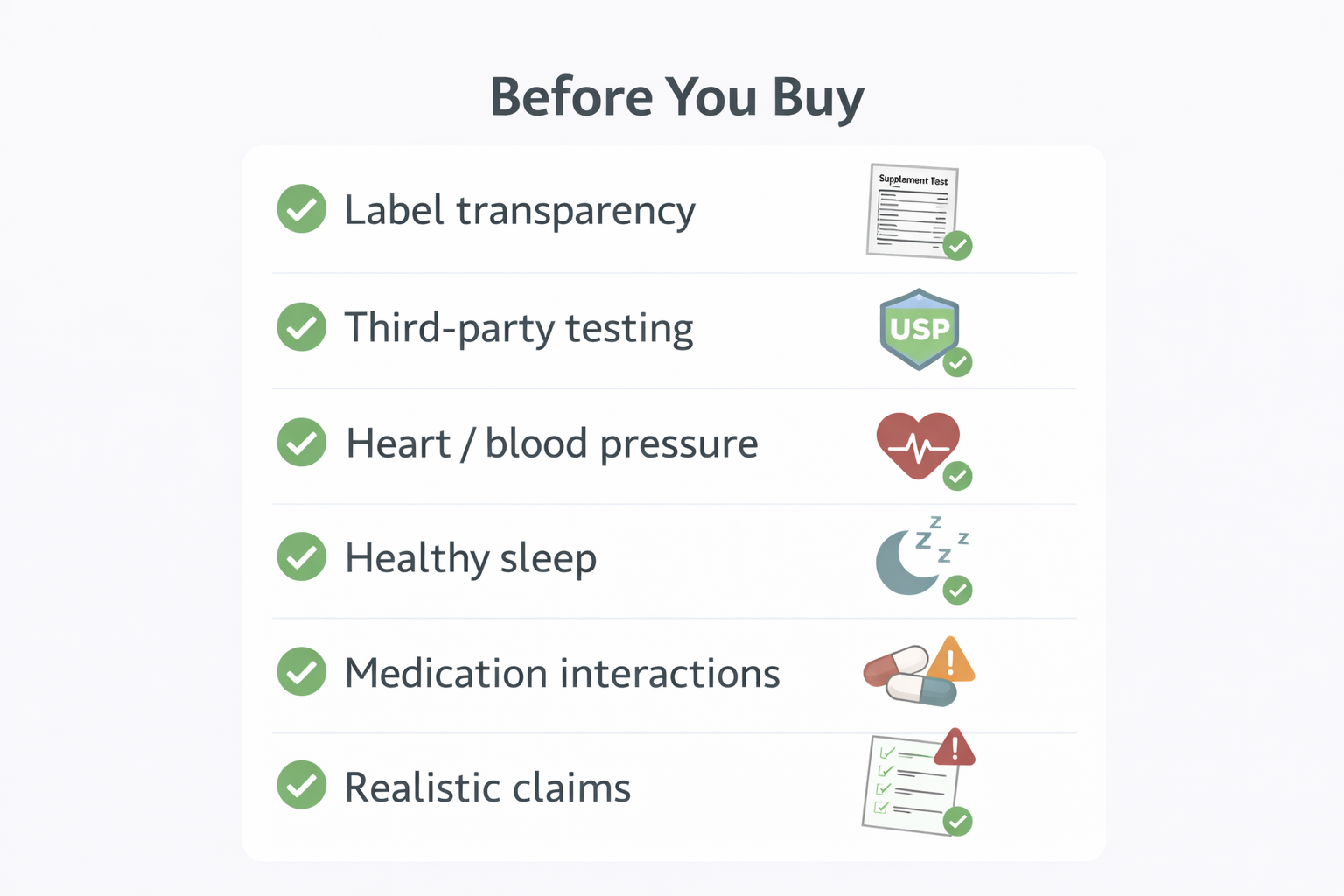
What to look for ✅
✅ Full Supplement Facts panel with exact amounts (not hidden in a blend)
✅ Clear caffeine content listed in milligrams (if it contains stimulants)
✅ A lot number and a real manufacturer address
✅ Third-party testing seals where you can verify the listing (for example, USP or NSF programs)
✅ Conservative claims that match what the ingredient can plausibly do
What to avoid 🚫
🚫 “Proprietary blend” as a way to hide dosing
🚫 Imported products with no manufacturer traceability
🚫 Social media “miracle” brands that appear and disappear quickly
🚫 Multi-product stacks that combine several stimulant sources
Quality checklist table you can screenshot
| ✅ Better choice | 🚫 Higher risk |
|---|---|
| Transparent dosing for each ingredient | Proprietary blend with no amounts |
| Verifiable third-party testing | No testing info, no batch traceability |
| Conservative claims (supports appetite, supports energy) | Extreme claims (melt fat fast, works without lifestyle change) |
| Sold by reputable retailers and clinics | Mostly sold through sketchy ads and pop-up pages |
Results: what most people actually see (and why expectations matter)
For most people, the “headline” results they see online are not typical. The NIH consumer guidance emphasizes that proven weight loss comes from eating healthful foods, reducing calories, and being active, and it notes that sellers may make claims despite limited scientific evidence of effectiveness.
That does not mean every product is useless. It means you should set the right target:
-
If it helps you stick to a calorie deficit more consistently (less snacking, fewer “second dinners,” fewer drive-thru stops), that is a real benefit.
-
If it only “boosts metabolism” but increases cravings later, disrupts sleep, or spikes anxiety, it often hurts more than it helps.
OTC pills vs supplements are not the same thing
One important nuance: some over-the-counter “weight loss pills” are actually drugs, not supplements. A classic example is orlistat (Alli), which reduces fat absorption and has evidence for modest additional loss when paired with lifestyle changes. Mayo Clinic summarizes that people using Alli with diet and exercise lost a small additional amount over a year compared with lifestyle alone.
That is still not magic. It is a small edge, and it comes with GI side effects for many people.
The safety issue people do not expect: contaminated products
One of the biggest reasons clinicians are cautious is contamination or adulteration. The FDA has an initiative specifically addressing contaminated weight loss products and notes that many products marketed as supplements have been found to contain hidden prescription drugs or chemicals, and that FDA cannot test all products on the market.
This is also why “works unbelievably well” can be a warning sign. If something produces dramatic appetite suppression or rapid drops without lifestyle changes, it may be spiked with a drug ingredient.
Which option is usually best: DIY add-ons or medical support?
This is the “which is best” question most people really mean. The answer depends on your starting point, health risks, and timeline.
When a low-risk OTC add-on might be reasonable
A cautious, low-risk add-on can make sense when:
-
You are generally healthy, not pregnant, and do not have heart or blood pressure issues
-
Your main barrier is appetite consistency
-
You choose a transparent product and use it short-term as a behavior support tool
-
You are already working on the fundamentals (protein, fiber, steps, sleep)
In this lane, you are usually looking at fiber support, protein support, or a modest caffeine approach that does not ruin sleep.
When a medical program is the smarter “best option”
Medical support tends to be the better fit when:
-
You have obesity-related conditions (high blood pressure, prediabetes/diabetes, fatty liver, sleep apnea)
-
You have tried multiple attempts and keep regaining
-
You suspect hormones, medications, or insulin resistance are major drivers
-
You want real accountability, lab-guided decisions, and safe prescription options when appropriate
Explore our medical weight loss program in Greenville, NC
In a supervised plan, the “best” tool might not be a supplement at all. It could be nutrition coaching, structured tracking, anti-obesity medication, or treating a barrier like sleep apnea that is driving hunger.

A practical decision path for Greenville and Pitt County residents
If you want a simple way to choose without getting overwhelmed, follow this path:
-
Decide what you want the product to do: appetite control, energy for workouts, better consistency, or “quick scale drop.” If the goal is “quick drop,” pause. That is where most risky choices live.
-
Match the tool to the goal: appetite goals usually align better with fiber/protein strategies than heavy stimulant stacks.
-
Run a safety check: blood pressure, anxiety, sleep issues, medications, pregnancy status. If any are relevant, do not guess.
-
Buy the most transparent option you can find, and use it as a short-term support, not a long-term crutch.
-
If you have tried this cycle before and regain keeps happening, move to a clinician-guided plan.
If you want help picking the safest path for your body and goals, Request a consultation
Next Step: weight loss supplements and a safer plan
If you are considering a product, the best “win” is not finding a miracle bottle. It is avoiding risky shortcuts and choosing tools that support consistency: better appetite control, better sleep, and a plan you can repeat week after week.
A consultation can also help you avoid wasting money on products that do not match your health profile, especially if you are dealing with blood pressure concerns, medications, or stubborn regain.
Frequently Asked Questions
What is the best supplement for weight loss?
The best choice is the one that improves consistency without harming sleep or blood pressure. For many people, that points to simple appetite-support strategies like fiber (to feel fuller) and protein support (to reduce grazing), because they help you stay in a calorie deficit without the roller coaster that stimulants can cause. If you have medical conditions, the “best” option might be skipping supplements altogether and focusing on a clinician-guided plan so you do not accidentally worsen anxiety, raise blood pressure, or interfere with medications.
How to lose 20 pounds in a month?
Losing 20 pounds in a month is unrealistic for most people and can be unsafe without medical supervision. Fast loss is sometimes possible early on for certain individuals, but it often reflects water shifts, severe restriction, or dehydration, not sustainable fat loss. Extreme deficits can increase binge risk, fatigue, dizziness, and gallbladder issues, and they frequently lead to rebound regain. A safer approach is to set a realistic timeline, tighten food quality and portions, increase daily movement, and get help if you have metabolic barriers like insulin resistance or sleep apnea.
Which supplement is best for fat loss?
No supplement reliably “targets” fat loss; it can only support behaviors that create a calorie deficit. If an ingredient helps you eat fewer calories consistently or stick to workouts, it may indirectly support fat loss over time. For many people, that means appetite support (fiber/protein) or a modest energy boost that does not disrupt sleep. Be cautious with products that claim spot reduction or dramatic “fat melting,” because those claims are usually marketing, and in the worst cases they can signal contaminated products.
What is the best weight loss pill over the counter?
The most evidence-based OTC “pill” is typically an FDA-approved option, not a random fat burner blend. Orlistat (Alli) is one example often discussed, and it can produce modest additional loss when paired with diet and exercise, but it commonly causes GI side effects and requires realistic expectations. Many other OTC pills are supplements with limited evidence and wide quality variation. If you are unsure, bring the exact product label to a consultation so it can be screened for safety, interactions, and whether it is worth the cost.
What is the closest thing to Ozempic over-the-counter?
There is no true over-the-counter equivalent to Ozempic or other prescription GLP-1 medications. Prescription GLP-1s work through specific hormonal pathways and dosing that are regulated and monitored. OTC products that claim to be “the same” are not the same, and those claims are a red flag. If you are interested in GLP-1 style appetite control, the safest next step is a medical evaluation to see whether you qualify for a monitored treatment plan and what alternatives fit your health history and goals.
Do any OTC weight loss pills actually work?
Some can help a little, but results are usually modest and depend heavily on lifestyle changes. The NIH notes that many supplement ingredients marketed for weight loss have limited scientific support, and marketing claims often run ahead of evidence. The “working” outcome you should look for is improved adherence: fewer cravings, fewer impulsive snacks, and better consistency with movement. If a pill makes you jittery, ruins sleep, or spikes anxiety, it often sabotages progress. When in doubt, a supervised plan usually beats trial-and-error.