

Weight Loss Programs: How to Choose the Right Program in Greenville, NC
Weight loss programs are most effective when the plan fits your health needs, schedule, and support style in Greenville, NC. The “right” choice usually comes down to coaching consistency, realistic food structure, and smart progress tracking, not willpower.
If you live in Greenville, Winterville, Ayden, Farmville, or anywhere in Pitt County, it helps to know what you are actually buying when you join a program: structure, accountability, and a method that reduces guesswork.

Why Choosing the Right Program Matters (Especially in Real Life)
Most people do not struggle because they “do not know what to do.” They struggle because life makes consistency hard.
A program works when it removes the two biggest friction points:
-
Decision fatigue (What am I eating? How much? What do I do when I am busy?)
-
Invisible drift (You start strong, then weekends, stress, travel, or late nights slowly pull you off track)
The best outcomes typically come from a plan you can repeat on normal weeks and still follow on messy weeks. That is why reputable guidance often emphasizes gradual, steady loss, because it is more likely to stay off.
If you have tried “eat less, move more” a dozen times, your next step is not more pressure. It is better structure.
What Makes a Program Actually Work (Not Just the Scale)
A good program has three parts working together:
1) A food framework you can follow without perfection
This is not about a magical menu. It is about repeatable meals you can run on autopilot. Many people do best with a protein-forward pattern because it improves fullness and makes calorie targets easier to hit.
2) Accountability that shows up before you quit
Weekly check-ins (in person or virtual) catch problems early. When a coach helps you adjust quickly, you spend less time stuck in “start over Monday.”
3) Progress tracking that reduces guesswork
If you only use a scale, you will overreact to water swings (salt, hormones, stress, travel). That is why some clinics use body composition scans to track fat, muscle, and water changes over time and keep adjustments targeted.
📌 Related reading for Pitt County locals who want the numbers side: Calorie deficit guide for fat loss
The Main Types of Programs You Will See Around Greenville (And What They Are Best For)
You will usually see a handful of “program models.” None is perfect for everyone, but one is usually best for you.
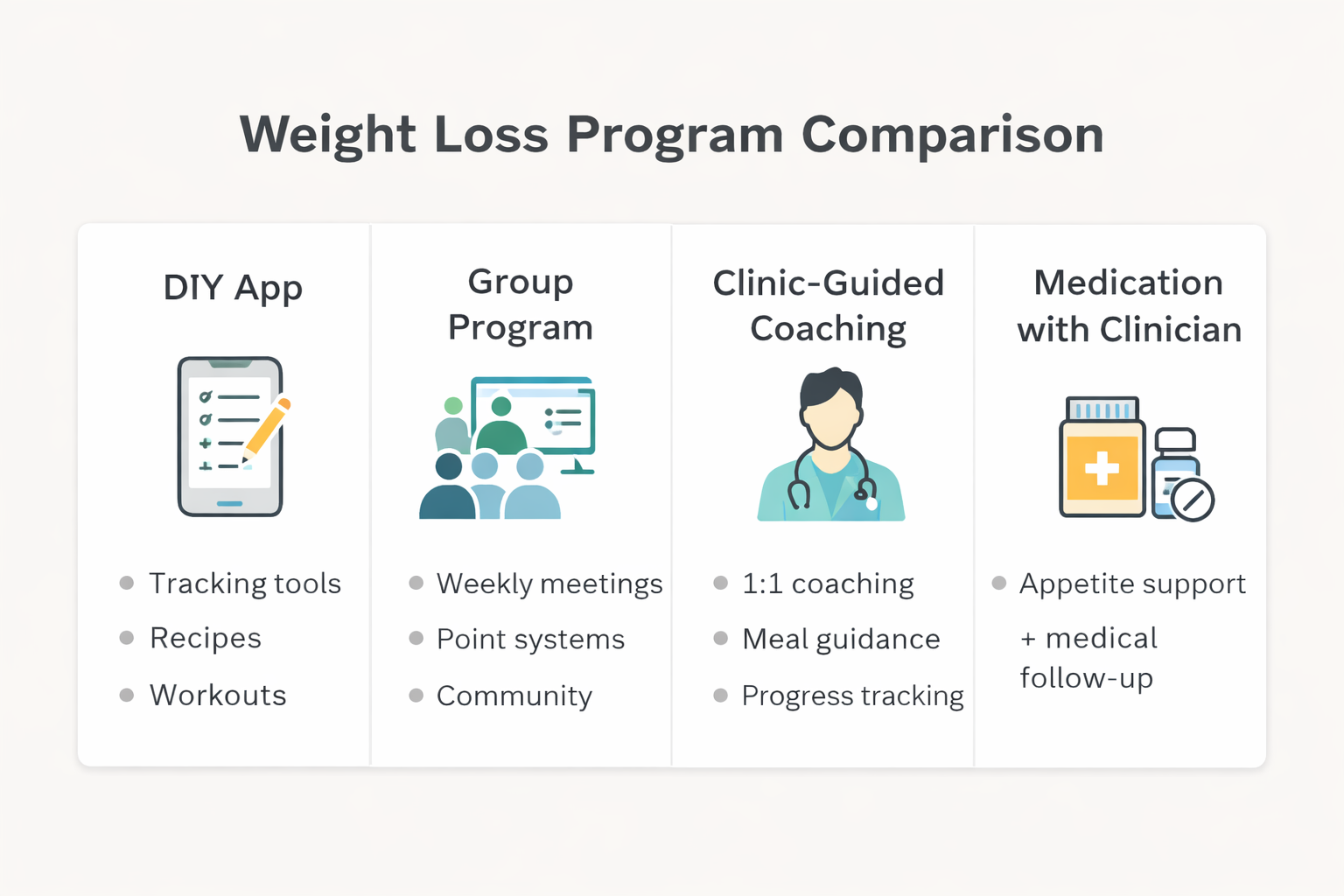
Here is a simple comparison you can use before you spend money.
| Program Type | What You Usually Get | Best Fit If You… | Watch Outs |
|---|---|---|---|
| DIY app or self-guided plan | Tracking tools, recipes, workouts | Are already consistent and just need a system | Easy to quit quietly when life gets busy |
| Commercial group program | Weekly meetings, point systems, community | Want peer support and simple rules | Can feel generic if you have medical variables |
| Clinic-guided coaching program | 1:1 coaching, meal guidance, progress tracking | Have dieted repeatedly, plateau often, or want higher accountability | Quality varies. Ask how they measure progress and adjust |
| Medication-only approach (through a prescriber) | Appetite support + medical follow-up | Meet criteria and need appetite help | Works best when paired with skills so regain risk is lower |
In Greenville, you will also see clinics marketing “no shots” approaches or hybrid options. For example, East Carolina Weight Loss highlights a free consultation and body composition scan and emphasizes “no shots, no surgery,” with coaching and meal guidance.
How to Choose the Best Weight Loss Program (A Greenville-Friendly Checklist)
This is the part most people want answered quickly: Which option is best?
The best weight loss program is the one that matches your barriers, not your motivation on day one.
Use this decision checklist as your filter.
Step 1: Decide what success means for you (beyond pounds)
If your only goal is a number, you will miss what actually changes your life: energy, sleep, labs, cravings, joint pain, and clothing fit.
✅ A strong goal sounds like:
“I want steady fat loss while keeping muscle, fewer cravings at night, and a plan I can maintain through weekends.”
A good starter target many clinicians use is 5% to 10% body weight reduction, because even that can improve health risk factors for many people.
Step 2: Identify your biggest barrier (be honest)
Most people in Pitt County fall into one of these patterns:
-
“I do fine Monday to Friday, then weekends undo it.”
-
“Stress eating hits at night.”
-
“I do not eat enough protein early, then snack all day.”
-
“I lose for a bit, then stall and panic.”
If plateaus are your recurring story, this article is worth bookmarking: Plateau and stress eating help
Step 3: Match the support level to your timeline
If you want faster progress, you typically need tighter structure and more frequent course-correction. If you want slow and steady, you can often use lighter support.
Health authorities commonly recommend gradual loss of about 1 to 2 pounds per week for sustainability, which usually means a moderate calorie deficit rather than extreme restriction.
Step 4: Ask how they measure progress and adjust the plan
A quality program should tell you:
-
What they track weekly (scale averages, measurements, habits, scans)
-
How they respond when loss stalls
-
How they protect muscle (protein targets, strength work, step goals)
Here is a quick “what to ask” table you can bring into your consult.
| Question to Ask | Why It Matters | What a Good Answer Sounds Like |
|---|---|---|
| “How do you adjust when I plateau?” | Plateaus are where most people quit | “We review adherence, hunger, steps, and trend data, then adjust one variable at a time.” |
| “How do you track fat vs muscle?” | Scale loss can be water or muscle | “We use consistent measurements and may use body composition tracking to guide changes.” |
| “What happens after I hit my goal?” | Maintenance is where long-term success lives | “We taper check-ins and build a relapse plan for travel, holidays, and stress weeks.” |
| “Is this plan realistic for restaurants and family meals?” | Greenville life includes events and eating out | “We teach swaps and a simple meal pattern you can repeat anywhere.” |

What a Consultation Should Feel Like (And What to Bring)
A good consultation should feel practical, not salesy.
In a clinic-guided model, you should expect an intake that considers your history, symptoms, goals, and barriers, plus objective measurements so you are not guessing.
✅ Before you go, bring these three things:
-
Your top 2 to 3 goals (energy, labs, waist, clothing fit, pain reduction)
-
A list of medications and supplements
-
Your real weekly schedule and your biggest barrier (weekends, stress eating, cravings, meal planning)
If you already know you want clinic-based structure, you can review medical weight loss in Greenville, NC to see what a coaching-first, clinic-guided approach looks like.
Practical Tips That Make the First 14 Days Easier (So You Actually Stick With It)
Most people do not need a perfect plan. They need a plan that is easy to start.
Here are a few high-leverage moves that work well for busy Greenville schedules:
Use a “repeat breakfast” that hits protein
If mornings are chaotic, make breakfast boring in a good way. A consistent protein-forward breakfast reduces snack urgency later in the day.
You might also hear about the “30/30/30” morning routine: 30 grams of protein within 30 minutes of waking, then 30 minutes of low-intensity exercise. It is popular because it is simple, and the protein piece can help with fullness. It is not magic, but it can be a useful structure if mornings are your weak spot.
Pick one lunch you can run on autopilot
Example: a big salad bowl with chicken, beans, crunchy veggies, and a measured dressing. Or a wrap plus fruit and Greek yogurt. The point is consistency, not novelty.
Give yourself a “restaurant plan” for Winterville, Ayden, and Farmville nights
Instead of avoiding eating out, decide your default order style:
-
Protein + veg + one carb you actually enjoy
-
Skip liquid calories most days
-
If dessert happens, share it and move on
Track weekly trends, not daily emotion
Daily weigh-ins can help some people, but only if you use weekly averages and do not panic over normal fluctuations. If your program uses body composition tracking, even better, because the goal is fat loss with muscle protected, not simply “down on the scale.”
When a Clinic-Guided Program Is Usually the Best Fit in Pitt County
You may want higher-support care if:
-
You have regained weight multiple times after dieting
-
Hunger and cravings feel intense
-
You hit plateaus often and do not know why
-
You want objective tracking beyond the scale
-
You want a plan that can be done in-office or virtually, depending on your schedule
In Greenville, East Carolina Weight Loss describes weekly coaching, meal guidance, and body composition scans to guide adjustments, plus a free consultation to build a starting plan.
If you want a broader overview of local options and what to expect, start here: weight loss in Greenville, NC.
Wrap-Up: Your Next Step for Weight Loss Programs in Greenville, NC
If you are tired of guessing, your best move is to choose one program model, commit to it long enough to get real data, and adjust with support instead of restarting alone.
If you want a structured, coaching-first plan with clear tracking, Request a consultation and bring your goals, meds list, and weekly schedule so the plan fits your real life.
Frequently Asked Questions
Which is the most effective weight loss program?
The “most effective” program is usually the one you can stick with long enough to create a consistent calorie deficit while building habits you’ll keep. Research comparing commercial programs in randomized trials shows modest but meaningful advantages for structured plans that include coaching, accountability, and clear food guidance; for example, Weight Watchers and Jenny Craig produced greater average weight loss at 12 months than minimal education or counseling in studied populations. If you have obesity-related health issues, the most effective “program” may also include clinician-guided options like anti-obesity medication or bariatric surgery alongside lifestyle changes.
How can I lose 20 lbs in a month?
For most people, losing 20 pounds in 30 days isn’t considered safe or sustainable, and a lot of “fast loss” ends up being water and muscle rather than fat. Public-health guidance typically points to a gradual pace—about 1–2 pounds per week (roughly 4–8 pounds per month)—because it’s more likely to stay off and carries fewer risks. If rapid loss is medically necessary (for example, before a procedure), it should be done only under medical supervision with a tailored plan and monitoring. Otherwise, aim for steady habits: a manageable calorie deficit, protein and strength training to protect muscle, and sleep/stress support.
What did Kelly Clarkson use for weight loss?
Kelly Clarkson has said her weight loss involved a prescription medication, but she emphasized it was not Ozempic. She described it as a medication that helps her body “break down” or process sugar, and she said she chose it after her blood work worsened and she was told she was pre-diabetic; she also mentioned hesitating at first due to thyroid concerns. In addition to medication, she has credited lifestyle changes like being more active (walking more after moving to New York City) and focusing on a protein-forward approach under her doctor’s guidance. She has not publicly named the exact drug.
What is the 30 30 30 rule for weight loss?
The 30-30-30 rule is a morning routine: eat 30 grams of protein within 30 minutes of waking, then do 30 minutes of low-intensity “steady state” exercise (like brisk walking). The idea is that a higher-protein breakfast may improve fullness and help with blood-sugar control, while early movement increases daily activity consistency. The big caveat is evidence: experts note there aren’t major clinical trials proving the specific timing rule is uniquely effective for weight loss, even if the components (adequate protein and regular exercise) are generally beneficial. Think of it as a simple habit framework, not a guarantee.
How did Kim Kardashian lose 15 pounds in 3 weeks?
Reports usually refer to her 2022 Met Gala preparation, where Kim Kardashian said she lost about 16 pounds in roughly three weeks to fit into Marilyn Monroe’s dress. She described an extremely strict, short-term regimen that included cutting out sugar and carbs, focusing on “clean” foods, and using intense sweating/exercise tactics like sauna suits alongside workouts. It’s worth noting this was a time-limited, high-pressure celebrity goal, and many clinicians criticize crash-style approaches because they can be risky, rebound quickly, and reinforce unhealthy dieting behaviors. If you’re trying to lose weight, safer results come from a slower pace with a plan you can repeat for months, not weeks.
At what age is it hardest to lose weight?
There isn’t one “magic” age, but people often feel it gets harder in midlife because routines change (less movement, more stress, less sleep) and because muscle mass gradually declines with age, lowering daily calorie needs. Large metabolic research suggests total energy expenditure stays fairly stable from about ages 20 to 60, so the common “my metabolism crashed at 30” story is often more lifestyle than biology. For many women, the menopause transition (often in the late 40s to 50s) can make weight management harder due to hormonal shifts, changes in body-fat distribution, and age-related muscle loss; after about 60, average energy expenditure tends to decline further.